Ethics and Etiquette
Taikikai Dojo Reiho
Budo studies take place in a training space – the dojo – and begin with learning the etiquette that applies there: dojo reiho and reigi.
Behaviour in the dojo reflects how we regard and respect the dojo, our fellow practitioners, and our teachers. Equally important in budo studies is ensuring everyone's safety and taking moral responsibility never to use acquired knowledge and skills to injure others or to inflate one's own ego.
Dojo
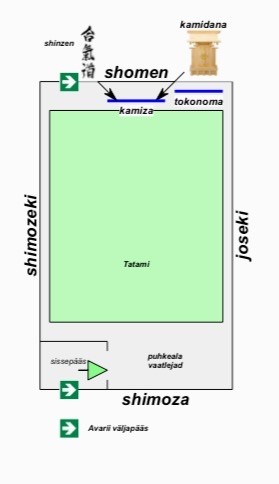
The dojo has four sides: the upper or front side – shomen; the lower side – shimoza; the right side – joseki; and the left side – shimozeki. In earlier times, the sides of the dojo were oriented according to the cardinal directions, with the shomen side preferably facing north. When the layout of the building does not allow orientation by cardinal directions, the dojo must be designed based on available possibilities and basic ethical requirements (e.g. toilets, changing rooms, or the main entrance should not be placed next to the shomen). On the shomen side is the dojo's upper place – kamiza – where altars – kamidana and/or shinzen – may be located. To the right of the kamiza there may be an alcove – tokonoma.
TAIKIKAI Dojo Reiho
Every person present in the dojo is responsible for behaving with propriety and in accordance with the rules in force. Each person is also responsible for fostering the positive, harmonious, and respectful atmosphere that is characteristic of budo.
Outdoor footwear is not worn inside the dojo. Upon entering through the door, a standing bow (tachi rei) is made towards the kamiza on the shomen side. A kneeling bow (zarei) is made when stepping onto the tatami. Bowing should not be seen as a religious ritual directed at a "god", but as an expression of respect for the spirit and ethos of budo.
The dojo is not used for anything other than budo studies and training. Other training sessions and events may only be held in the dojo with the permission of the dojo keeper – dojo sho.
While in the dojo, everyone is obliged to observe sanitary and hygiene requirements. Outdoor clothing and footwear are not worn inside the dojo.
It should be remembered that there is no serving staff in the dojo whose task would be to clean up after others and maintain the dojo.
Cleaning and maintaining the dojo is one of the ways to demonstrate one's attitude and respect. Every dojo member and training participant is obligated to take part in cleaning and maintaining the dojo.
Cleaning and maintaining the dojo is connected with both the educational and the learning process, during which one also cleanses one's spirit, senses, and heart – kokoro.
Everyone is responsible for having their personal equipment and accessories in good working order. Personal equipment and accessories are not left scattered around the dojo but are taken along or stored in the designated place.
When watching training as a spectator, one must remain quiet and seated in the designated areas. Phones and other distracting devices must be switched off or set to silent mode.
Guests may participate in training or watch as spectators only with the permission of the instructor – sensei – conducting the training.
Dojo members form a family whose goal is to learn budo and its secrets. Dojo membership is one of the ways to demonstrate one's attitude towards learning and the dojo, and a form of gratitude. It also enables one to have a place and environment for training and self-development.
Budo knowledge and skills cannot be bought; they can only be acquired through consistent study and training.
Dojo membership and tuition fees make it possible to participate in the learning process and help maintain the dojo. Out of respect for the dojo, the training opportunities, and each individual, every student and training participant has the responsibility to pay the required fees on time.
Voluntary assistance in organising and participating in dojo events demonstrates a person's attitude and dedication to budo studies and the dojo.
Training is always attended fully prepared – mentally, physically, and in terms of equipment.
Phones are not used on the training surface – tatami – and during training, all phones in the entire dojo are either switched off or set to silent mode.
The use of photographic and video equipment in the dojo is permitted only with the consent of the dojo sho and/or the sensei conducting the training.
Every person must have the following hygiene and sanitary items: washing supplies and a towel; a set of plasters and, as needed, other personal hygiene and sanitary items.
Drinking bottles and containers must be kept off the tatami, and it must be ensured that liquids do not spill. Used hygiene and sanitary items, empty containers, and other waste generated for personal use are not left in the dojo but taken along when leaving.
Any soiling of the tatami surface during training (e.g. blood) must be cleaned immediately.
It is important to respect every teacher who conducts training and the way in which they do so. It is equally important to listen attentively and receive with an open mind the recommendations and guidance given by the teacher.
During training there is no place for arguing about others' actions or for mutual disputes. Conflict of egos must be avoided on the tatami.
On the tatami, one learns to tame aggressive emotions and reactions and develops the spirit of budo, thereby cultivating – in addition to general courtesy – a sense of social responsibility.
One must be aware of one's own abilities. Each person has different physical, mental, and learning capabilities and needs. These capabilities and needs must be respected.
It is the responsibility of practitioners not to cause injury to their training partner or to themselves.
Each different budo training session (e.g. aikido, iaido, or naginata) may have its own guidelines established for that discipline – reigi – which govern the opening and closing ceremony of training, the conduct of training, communication among practitioners and with the teacher, etc., which must be observed during training.
The Taikikai Reigi guidelines are based on the general rules of Taikikai dojo – Taikikai dojo reiho.